Boavista: The End of One of Football's Greatest Underdog Stories
Some football clubs are remembered for dynasties.
Others for legendary players.
Boavista Futebol Clube will be remembered for proving that giants can fall and that underdogs can rise.
For over 120 years, Boavista represented something increasingly rare in modern football: a club capable of challenging the established order without possessing the wealth or global stature of its rivals. They became champions in a league dominated by Portugal's "Big Three," competed regularly in Europe, and built one of the country's proudest footballing traditions.
On 16 July 2026, after years of financial turmoil, court battles, and mounting debt, Boavista received a court order to cease all footballing operations by 31 July and surrender its facilities.
One of Portugal's oldest football clubs had reached its final whistle.
Humble Beginnings
Boavista was founded in 1903 in Porto by British entrepreneurs Harry and Dick Lowe, alongside Portuguese textile workers employed by their company.
Like many early football clubs across Europe, Boavista spent decades searching for stability.
The club bounced between the Primeira Divisão and Segunda Divisão throughout much of the first half of the twentieth century before suffering another setback in 1966, falling into the Terceira Divisão, Portugal's third tier.
For many clubs, that would have marked the beginning of a slow disappearance.
Instead, Boavista responded.
Back-to-back promotions saw the club return to the top flight by 1970, laying the foundation for the most successful era in its history.
Becoming Portugal's Fourth Giant
The 1970s transformed Boavista.
After finishing fourth in the 1974–75 Primeira Divisão, the club lifted its first-ever Taça de Portugal, defeating Benfica 2–1 in the final.
A year later, they nearly captured the league title, finishing just two points behind Benfica before successfully defending the Portuguese Cup with another 2–1 victory over Vitória de Guimarães at Porto's Estádio das Antas.
Under legendary English manager Jimmy Hagan, Boavista captured three Taça de Portugal trophies within five years, defeating another Portuguese powerhouse, Sporting CP, along the way.
The success continued.
At the beginning of the following season, Boavista and Porto contested the inaugural Portuguese Super Cup, created to pit the league champions against the domestic cup winners.
Boavista defeated Porto 2–1 in a fiercely contested match despite finishing with only nine men after two red cards.
For perhaps the first time, Portuguese football realized Boavista were no longer simply outsiders.
They were contenders.

Building Toward Greatness
The following two decades were defined by consistency.
Boavista rarely challenged for league titles but established themselves as one of Portugal's most respected clubs, regularly finishing in the top half of the table while collecting two more Taça de Portugal titles during the 1990s.
Everything changed in 1997.
Club president Valentim Loureiro handed leadership to his son, João Loureiro, who at just 34 years old became the youngest president in the Primeira Liga.
Soon after, former Portugal international Jaime Pacheco was appointed manager.
The partnership would change Portuguese football forever.
Boavista finished runners-up in 1999, fourth in 2000, and entered the 2000–01 campaign believing they could compete with anyone.
Very few believed they could actually win it.

The Impossible Champions
Then came one of the greatest seasons in Portuguese football history.
Boavista defeated rivals Porto in the second half of the campaign before securing the league title on 18 May 2001, defeating Aves 3–0.
It remains one of the greatest underdog stories the league has ever seen.
They became only the second club outside Portugal's "Big Three" (Benfica, Porto, and Sporting CP) to win the Primeira Liga, following Belenenses' remarkable triumph in 1946.
Pacheco's side conceded just 22 goals in 34 matches, losing only once at home all season.
It wasn't a fluke.
It was one of the finest defensive campaigns Portuguese football has ever witnessed.
For one unforgettable year, Boavista stood at the summit of Portuguese football.
European Nights
Success at home translated into memorable nights across Europe.
Throughout the late 1990s and early 2000s, Boavista became regular participants in UEFA competitions, proving they belonged among Europe's elite.
Their greatest continental achievement came during the 2002–03 UEFA Cup, where they reached the semi-finals before suffering a heartbreaking 2–1 aggregate defeat to Celtic, decided by a late Henrik Larsson goal.
Had that strike never happened, Boavista would have faced Porto in an all-Portuguese European final.
Instead, one moment separated them from history.

The Beginning of the End
The warning signs were already emerging.
Following their league triumph, Boavista rebuilt the Estádio do Bessa ahead of UEFA Euro 2004, a project that significantly increased the club's financial burden.
Then came the Apito Dourado (Golden Whistle) scandal.
In June 2008, Boavista were relegated for their involvement in the Portuguese match-fixing investigation surrounding three matches during the 2003–04 season.
Whether fair or not, the punishment fundamentally altered the club's future.
Just one year later, financial problems forced Boavista to withdraw from the second division despite initially avoiding relegation following sanctions handed to Vizela.
The club had gone from national champions to fighting for survival.

Fighting to Survive
Boavista refused to disappear quietly.
Following years of legal battles, the club won the right to return to the Primeira Liga in 2013.
Negotiations reduced their estimated €65 million debt by half, allowing the club to rebuild.
After a six-year absence, Boavista returned to Portugal's top flight for the 2014–15 season, managed by Petit, himself a member of the legendary 2001 championship squad.
Even then, the obstacles continued.
FIFA transfer bans prevented Boavista from strengthening their squad for five separate transfer windows.
When those restrictions finally ended, the club signed nine players in a single day during February 2025 in a desperate attempt to remain competitive.
They were surviving.
But only just.
The Final Collapse
The 2024–25 season proved to be the breaking point.
A humiliating 4–1 defeat away to Arouca confirmed Boavista's relegation from the Primeira Liga, prompting hundreds of travelling supporters to invade the pitch in frustration.
Things only worsened.
The club was denied entry into Liga Portugal 2, while also being refused registration in Liga 3 and the Campeonato de Portugal.
Instead, Boavista's professional SAD was forced into the newly created Liga Pro, operated by the Porto Football Association.
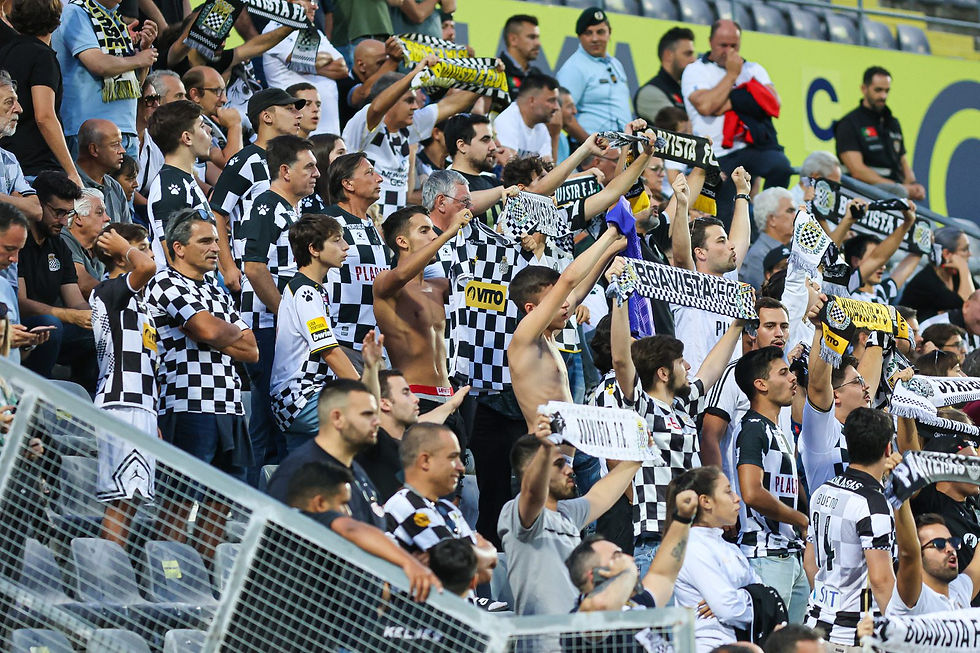
Meanwhile, the original club entered the district leagues, prompting supporters from the Panteras Negras ultras to establish their own breakaway club: Panteras Negras F.C.
Then came the final blow.
On 16 July 2026, Portuguese courts ordered Boavista to cease all operations by the end of the month, bringing more than a century of football history to an abrupt conclusion.
Years of unpaid debts, insolvency proceedings, and failed restructuring efforts had finally caught up with one of Portugal's most historic institutions.

More Than Another Club
Boavista's story isn't simply about bankruptcy.
It's about possibility.
They climbed from Portugal's lower divisions to become league champions.
They broke the monopoly of the "Big Three."
They lifted domestic trophies, reached European semi-finals, and proved that football's established hierarchy could be challenged.
In today's game, where financial power increasingly determines success, Boavista remains one of the last great examples that belief, smart management, and determination can still overcome overwhelming odds, even if only for a moment.
Their disappearance should concern football supporters everywhere.
Because if a club with over 120 years of history, a league title, European pedigree, and one of Portugal's most passionate fanbases can disappear...
Who's next?
Boavista may no longer exist as they once did.
But for one remarkable season in 2001, the underdogs conquered Portugal.
And football is richer because they did.
Theron Norrington
Founder & Editor, OffTheRecord
Independent journalism exploring the stories that shape sport, culture, and the world beyond the headlines.
© 2026 OffTheRecord. All rights reserved.
--
Photo Credits
Boavista Futebol Clube
Liga Portugal
UEFA
Getty Images
AP Photo
Reuters
Agence France-Presse (AFP)
Panteras Negras (Supporters Group)
Wikimedia Commons
Bibliography
Boavista Futebol Clube — Official Club History & Archives
Liga Portugal — Historical League Records
Federação Portuguesa de Futebol (FPF)
UEFA — Club & Competition Archives
FIFA — Historical Competition Records
RSSSF (Rec.Sport.Soccer Statistics Foundation)
Transfermarkt
Reuters
Associated Press (AP)
BBC Sport
The Athletic
A Bola
O Jogo
Record Portugal
Público
Mais Futebol
UEFA Europa League Archives (2002–03)
Portuguese football historical records and club financial reports



Comments