S.C.U. Torreense: A Second-Tier Club Back in European Competition?
How a club that hasn't played in Portugal's top flight since 1992 went from a second-tier promotion hopeful to Portuguese cup champions and then into the Europa League.
There are football stories that make sense.
A big club wins a trophy.
A newly promoted team survives.
A historic giant returns to Europe.
And then there are stories where you have to stop, look at the table, look at the competition rules, and ask:
How the hell did this happen?
S.C.U. Torreense is one of those stories.
The club from Torres Vedras, roughly an hour north of Lisbon, had spent decades living mostly outside Portugal's top flight. Torreense's most recent spell in the elite ended in the 1991–92 season, when they finished 16th and were relegated.
That was the same year the English Premier League was founded.
Since then, Portuguese football changed around them.
Torreense didn't.
They became a familiar name in the country's lower divisions, occasionally climbing toward the top but never quite making it back.
Until 2026.
And somehow, instead of simply returning to the Primeira Liga, Torreense found a completely different route into European football.
They won the Portuguese Cup.
Then they missed promotion.
Then they went to Norway and won their first Europa League match.
Now they're preparing to face Sunderland.
A second-tier Portuguese club is playing European football.
And this is how it happened.

A Club That Had Been Waiting Since 1992
Torreense's history is much older than their recent rise suggests.
The club's breakthrough came in 1954–55, when Torreense won the Segunda Divisão and earned promotion to Portugal's top flight for the first time.
Their first season in the top division immediately became one of the most important seasons in club history.
Torreense finished seventh.
They also reached the Taça de Portugal final.
The final was played at the Estádio Nacional do Jamor against Porto, and Torreense eventually lost 2–0.
It remains the closest they had ever come to winning Portugal's main domestic cup.
For decades, that 1956 final remained a piece of club folklore.
Torreense would eventually return to the top flight several times, but never for long.
Their most recent promotion came in 1990–91.
One season later, they were relegated again.
They haven't been back since.
For perspective, when Torreense last played in Portugal's top division, the world was still months away from the first Premier League season.
Manchester United had not yet won the Premier League.
The Champions League did not yet exist under that name.
And Torreense's 1956 cup final was still the biggest cup run in their history.
Until now.
The Long Road Back
Torreense eventually found themselves much further down the Portuguese pyramid.
Their modern revival began with the creation of Liga 3 and a 2021–22 title at that level.
That promotion brought them back into Portugal's professional second tier.
And the club gradually began to establish itself as a serious Liga Portugal 2 side.
The 2025–26 season was supposed to be about something very simple:
promotion.
Torreense finished third in Liga Portugal 2, putting themselves into the promotion/relegation playoff against Casa Pia.
Casa Pia had finished 16th in the Primeira Liga.
It was a classic football situation.
One club was fighting to stay alive.
The other was fighting to come back.
And Torreense had a chance to end 34 years outside the top flight.
But first, they had something else to deal with.
Something much bigger.
The Cup Run Nobody Saw Coming
Torreense entered the 2025–26 Taça de Portugal with a chance to make history.
They beat AD Correlhã.
Then Oliveirense.
Then Lusitânia Lourosa.
Then Casa Pia.
Then União de Leiria.
Then Fafe.
Suddenly, the second-tier club from Torres Vedras was in the Portuguese Cup final.
Waiting for them was Sporting CP.
One of Portugal's giants.
A club with a completely different financial scale, history, squad depth and expectation level.
And the final began almost perfectly for the underdog.
Four minutes.
That's all Torreense needed.
A corner came in from the left.
Léo Silva attacked the ball at the near post.
The header redirected it toward the far post.
And Kévin Zohi was there.
Another header.
Another touch.
Goal.
Sporting 0–1 Torreense.
The favorites had barely settled into the match.
Now they had to chase it.
Sporting dominated large portions of the game and eventually found their equalizer through Luis Suárez in the 54th minute.
The score became 1–1.
And stayed there.
Ninety minutes weren't enough.
Torreense were 30 minutes away from potentially becoming Portuguese Cup champions.

Stopira
The game reached the second half of extra time.
Torreense won a penalty.
And standing over the ball was Ianique Tavares, better known as Stopira.
A 38-year-old veteran centre-back.
This was not supposed to be his moment.
He wasn't a superstar.
He wasn't a famous goalscorer.
He was a defender.
But sometimes football gives the strangest characters the biggest stage.
Stopira stepped up.
Left foot.
Top-left corner.
2–1.
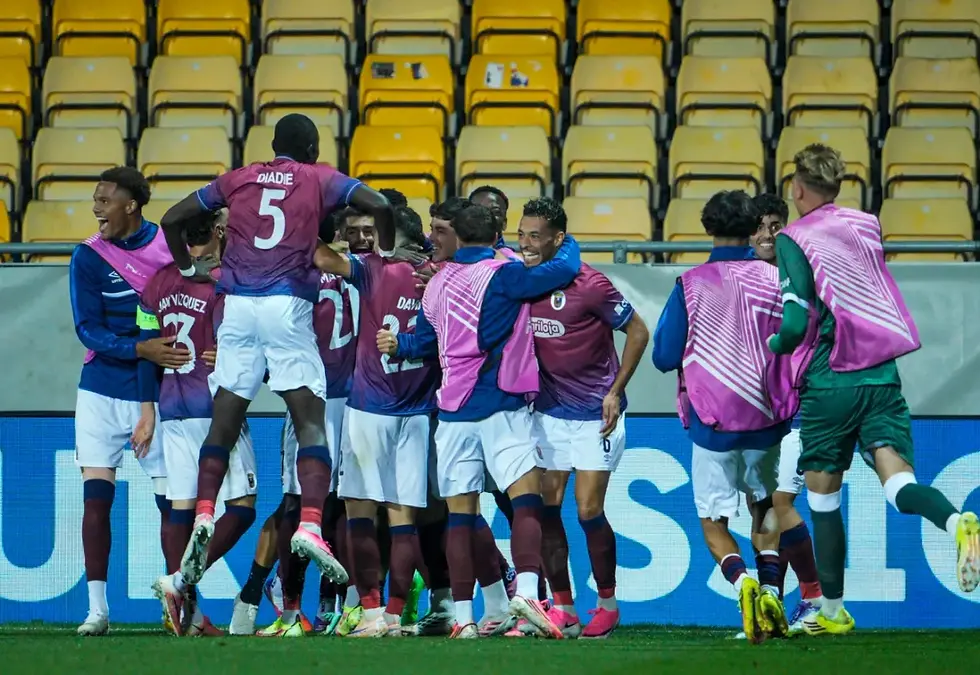
Torreense had done it.
They had beaten Sporting after extra time.
They had won the Taça de Portugal.
And, perhaps most importantly, they had done something that had never happened before:
Torreense became the first club from outside Portugal's top division to win the Taça de Portugal.
The club that hadn't been in the top flight since 1992 had just beaten one of Portugal's giants in a major final.
And they were going to Europe.

Except They Still Had One Problem
Remember that promotion playoff?
It was still there.
Torreense had just won the biggest trophy in their history.
They had secured European football.
But they still hadn't secured promotion.
Five days later, they played Casa Pia in the first leg.
0–0.
Everything was still alive.
Then came the second leg.
Casa Pia won 2–0.
Torreense's promotion dream was over.
The club had spent the entire season trying to get back to Portugal's top division.
They failed.
And somehow, they were still going to Europe.
That's the absurdity of this entire story.
Torreense weren't promoted to the Primeira Liga.
They qualified for Europe by winning the cup instead.
So while Casa Pia remained in the top flight, Torreense remained in Liga Portugal 2.
A second-tier club.
With a European place.
Welcome to Europe
The new season began.
And reality immediately hit.
Torreense haven't exactly started their Liga Portugal 2 campaign like a club destined for another promotion push.
After six matches, they had six points.
But the league wasn't the only competition on the calendar anymore.
There was another logo on the fixture list.
UEFA Europa League.
Torreense had gone from chasing promotion from Portugal's second tier to traveling around Europe.
Their first opponent?
Lillestrøm.
The Norwegian club had a similar story of their own.
Lillestrøm are traditionally a top-flight Norwegian club, but they had suffered relegation and immediately bounced back by winning the second tier unbeaten, finishing an astonishing 25 points ahead of Start.
They had also earned European football by winning the Norwegian Cup, defeating Brann in the final.
So this wasn't simply Torreense arriving in Europe to face some random giant.
They were facing another club with a very strange route into the competition.
And Torreense didn't care.
They won.
Lillestrøm 1–2 Torreense.
A club from Portugal's second division had gone to Norway and won its first Europa League league-phase match.

And Now Comes Sunderland
And this is where the story gets even better.
Torreense's next European opponent is Sunderland.
A Premier League club.
A club that has also just returned to European competition after decades away.
Sunderland's opening Europa League match was against AZ Alkmaar.
They won 1–0 through an Enzo Le Fée penalty.
It was their first European appearance since 1973.
Now they travel to Portugal to face a club whose story is almost impossible to explain without sounding like you're making it up.
Torreense vs Sunderland.
A second-tier Portuguese club against a Premier League club.
European football.
In October.
And Torreense won't even be playing at their normal home.

The Stadium Problem
Torreense's home, Campo Manuel Marques, is intimate.
That's part of the charm.
But European competition comes with infrastructure requirements.
And Torreense's normal home doesn't have the capacity required for their European matches.
So the club has had to move its European fixtures elsewhere.
That means the Torreense v Sunderland match will be played at the Estádio Dr. Magalhães Pessoa in Leiria.
Their European adventure is literally taking them away from home.
For a club whose identity is rooted in Torres Vedras, that's another strange chapter in an already bizarre story.

And There Is Another Torreense Story
The men's team isn't even the only part of the club experiencing an absurd rise.
The women's team has been building something remarkable of its own.
Torreense's women's side won the Taça de Portugal in 2024–25.
Then, during 2025–26, they added the Supertaça and Taça da Liga.
Three domestic trophies across roughly a year.
They also finished third in the league, qualifying for the Women's Champions League for the first time.
And their European story has continued into 2026–27.
The women have competed in both Champions League and Europa Cup competition this season, with UEFA recording Torreense's participation in the 2026/27 Women's Europa Cup.
So this isn't simply one men's team having a random cup run.
Something is happening at Torreense.
The entire club is moving.
From 1992 to Europe
There's something beautiful about the timeline.
1992: Torreense are relegated from Portugal's top flight.
2022: They win Liga 3 and begin climbing again.
2026: They reach the Taça de Portugal final for the first time in 70 years.
They beat Sporting.
They win their first major trophy.
They qualify for the Europa League.
They miss promotion.
They remain in the second tier.
Then they travel to Norway.
And win.
Now Sunderland are coming.
And suddenly, a club that spent decades trying to climb back into Portugal's top division is sitting in European competition.
That's football.
It doesn't always reward you in the order you expect.
Sometimes you don't get promoted.
Sometimes you don't get the league title.
Sometimes the biggest trophy of your life arrives through the side door.
Torreense didn't make it back to Portugal's top flight.
Not yet, anyway.
Instead, they found Europe.
And perhaps that's the funniest part of this entire story.
For 34 years, Torreense had been trying to get back to where they once were.
Now they've gone somewhere they've never been before.
European nights.
A Portuguese Cup.
A 38-year-old centre-back scoring the winning penalty.
A second-tier club playing Premier League opposition.
And a football club from Torres Vedras suddenly finding itself on a stage nobody could have predicted when the season started.
Maybe Torreense's story isn't about finally returning to the past.
Maybe it's about building something entirely new.
Because after everything that has happened in 2026, one thing is becoming increasingly difficult to argue:
Torreense are no longer just trying to come back.
They're making history on the way there.
Theron Norrington
Founder & Editor, OffTheRecord
Independent journalism exploring the stories that shape sport, culture, and the world beyond the headlines.
Photo Credits
Photos: S.C.U. Torreense, Liga Portugal Meu Super, UEFA, Liga Portuguesa de Futebol Profissional, Reuters, AFP/Getty Images, and credited photographers where applicable.
All photographs remain the property of their respective copyright holders. OffTheRecord does not claim ownership of third-party imagery.
© 2026 OffTheRecord. All rights reserved.



Comments