The Art of the Blue Dog
Not every underdog is a Blue Dog.
There is a little blue dog in The Legend of Zelda: Majora's Mask.
He is not particularly impressive.
He is not the fastest dog.
He is not the strongest dog.
He does not have some secret stat that makes him a hidden superstar.
In fact, if you were betting on him to win a race, the rational response would probably be to take your money, walk away from the betting window, and ask yourself why you were doing this in the first place.
And yet, somehow, this little blue dog can win.
It took nearly 25 years for somebody to properly prove it.
That is where I want to start.
Because sports has a word for the team nobody expects to win.
Underdog.
We use it constantly.
We use it for the fifth seed that beats the one seed. We use it for the newly promoted club that survives relegation. We use it for the team with the smaller budget, the worse roster, the less famous players, the fewer resources, the smaller stadium, the lower expectations.
But I don't think "underdog" goes far enough.
There are levels to this shit.
There is an underdog.
There is a heavy underdog.
There is a fairytale.
And then there is the Blue Dog.
The Blue Dog is what happens when reality looks at the probability of something happening and says:
Yeah, probably not.
And then it happens anyway.

So, What the Hell Is a Blue Dog?
Let's establish something before we start throwing this word around.
A Blue Dog is not simply a really good underdog story.
Leicester City winning the Premier League in 2016 was an underdog story.
The Cleveland Cavaliers coming back from 3–1 down against the greatest regular-season team in NBA history was an underdog story.
Wrexham going from the National League to the Championship in three consecutive promotions was an underdog story.
But not all of those are Blue Dogs.
And that distinction matters.
Because the entire point of the Blue Dog is that the circumstances surrounding the success are so ridiculous that "underdog" starts to feel inadequate.
Think of it as a spectrum.
The Underdog
An unlikely winner.
The team is worse on paper, but there is a reasonable path to victory.
Nobody should be shocked if it happens.
The Heavy Underdog
Now we're getting somewhere.
The team has significant disadvantages. The matchup is difficult. The odds are heavily against them.
If they win, it's a major upset.
The Fairytale Underdog
This is where the story becomes bigger than the result.
The circumstances, history, personalities and journey all combine into something extraordinary.
Leicester belongs here.
Sunderland's recent return to the Premier League and immediate qualification for the Europa League belongs somewhere around here too.
The Blue Dog
Now we're entering stupid territory.
The situation is so improbable that you begin questioning whether the universe itself has made an administrative error.
The team doesn't necessarily have to be terrible.
It doesn't even have to be the worst team involved.
It simply has to reach a situation where the reasonable conclusion is:
This should not happen.
And then it does.
The Pure Blue Dog
This is the final form.
The improbable thing happens once.
Then it happens again.
Then again.
The probability keeps screaming NO while reality keeps responding:
Watch me.
That is the Blue Dog.
And perhaps the greatest thing about the term is that it comes from a literal dog who, statistically speaking, had absolutely no business doing what he eventually did.
The Little Dog That Refused To Read The Script
In Majora's Mask, there is a dog racing minigame at Romani Ranch.
You can bet on the dogs.
There are different dogs with different speeds and different possible outcomes.
And among them is a slow little blue/black dog.
The Blue Dog.
For years, this became something of a running joke in the Zelda and speedrunning communities.
Because technically, the Blue Dog could win.
But actually seeing it happen?
Good fucking luck.
The story became so ridiculous that it stopped being merely a video-game curiosity and became a statistical problem.
YouTuber Vidya James dug deeply into the Doggy Racetrack and documented just how absurd the situation was. During a charity stream, Vidya James attempted to get the Blue Dog to win 1,300 times.
It didn't happen.
The game contains an enormous number of possible race configurations. The combinations are so numerous that trying to sample every possible race manually would take an incomprehensible amount of time—one estimate put the task at roughly 34 million years if every configuration were checked once per second.
That's the kind of number where you stop thinking about it as a video game and start thinking about geological time.
The dinosaurs could have been given controllers and they still wouldn't have finished.
Then came Falkush.
Using scripting and emulator tools, Falkush began systematically searching through the possible race outcomes rather than relying on somebody sitting there pressing a button over and over.
Eventually, after 8,410 races, a legitimate Blue Dog victory was found.
The exact mechanics of what counts as a legitimate win are part of the rabbit hole themselves. There was also a rare glitch involving the game's finish line that could produce an early result, which complicated the question of whether some apparent Blue Dog victories really counted.
But the underlying point remained:
The Blue Dog could win.
And eventually, it did.
After nearly 25 years of existing as the game's statistical punching bag, the slow little bastard finally got his moment.
And this is the thing I love about the story.
The Blue Dog didn't secretly become the best dog.
It didn't receive a stat boost.
Nobody patched the game.
Nobody redesigned the race.
The Blue Dog simply found the one tiny crack in the universe where the impossible became possible.
And that is what I mean when I say:
Blue Dog.
A Blue Dog is someone who looks at the laws of probability and says:
Fuck you.

1. Leicester City, 2015-16
The Legendary Underdog
Let's start with the obvious one.
If you are talking about ridiculous sporting achievements, Leicester City is impossible to leave out.
At the beginning of the 2015–16 Premier League season, Leicester were priced at 5,000–1 to win the league.
Five thousand.
To one.
That number became so famous that it almost doesn't sound real anymore.
Before the season began, Leicester were not regarded as a dark horse that could sneak into the Champions League.
They weren't some exciting young project everybody secretly believed could challenge the established order.
They were, quite reasonably, considered relegation candidates.
The previous season had ended with Leicester looking doomed before an extraordinary late run saved them. They finished 14th, but the broader expectation entering the following season was still that survival would be the objective.
Then Claudio Ranieri arrived.
And something broke.
Jamie Vardy went from lower-league footballer to one of the most feared strikers in England.
Riyad Mahrez transformed from an intriguing winger into a superstar.
N'Golo Kanté became an omnipresent midfield machine.
Wes Morgan became the captain of a Premier League champion.
Leicester lost only three league games all season.
And, gradually, the impossible became normal.
The conversation changed.
At first:
"Can Leicester stay up?"
Then:
"Can Leicester finish in the top half?"
Then:
"Can Leicester qualify for Europe?"
Then:
"Wait."
"Are Leicester actually going to win the league?"
The strangest thing about Leicester's season is that there wasn't one moment where the footballing world collectively realized what was happening.
It crept up on everyone.
The more Leicester won, the more difficult it became to dismiss them as a fluke.
By February, they weren't a cute little underdog story anymore.
They were the best team in England.
By April, they were champions-in-waiting.
And on May 2, 2016, Tottenham's draw with Chelsea officially crowned Leicester City Premier League champions.
The 5,000–1 outsiders had actually done it.
That is the thing about Leicester.
The achievement was so unlikely that it has become the definitive modern underdog story.
But I'm not sure it's a pure Blue Dog.
And that distinction is important.
Because Leicester eventually became a genuinely excellent football team.
They weren't accidentally winning matches every weekend.
They weren't scraping through every game by one lucky deflection.
They had a coherent system.
They had elite individual performances.
They had a manager who understood exactly how to get the best out of them.
The impossible became possible because Leicester were actually fucking good.
That's why I'd classify them as a Legendary Underdog.
Maybe Blue Dog-adjacent.
Maybe one paw in the door.
But not quite.
Verdict: Legendary Underdog.

2. Burnley, 2017–18
The One I'm Absolutely Not Biased About
I need to get this out of the way.
Yes.
I am a Burnley supporter.
No.
That does not make this example invalid.
Probably.
Burnley's 2017–18 season was fucking ridiculous.
Not in the same way Leicester's was.
Burnley didn't win the Premier League.
They didn't even come particularly close.
But they finished seventh.
And that meant European football.
Burnley qualified for the Europa League, securing European football for the first time in decades. It was one of the highest finishes in the club's modern history.
And here's what makes it so fun.
Burnley were Burnley.
This was not a team assembled with the resources of Manchester City.
They weren't playing some revolutionary football that had the entire world taking notes.
They were a brutally effective, incredibly organized, occasionally ugly football team that simply refused to go away.
Nick Pope.
James Tarkowski.
Ben Mee.
Stephen Ward.
Jack Cork.
Ashley Westwood.
Johann Berg Gudmundsson.
Chris Wood.
Ashley Barnes.
Sean Dyche.
Football terrorism, according to some people.
Beautiful football, according to me.
And somehow, it worked.
Burnley didn't need to dominate possession.
They didn't need to outspend everybody.
They didn't need to score three goals every week.
They needed to make themselves incredibly difficult to beat.
And they did.
For a while, the Clarets were doing something that is almost impossible in modern football: they were making a relatively limited squad look significantly better than the sum of its parts.
They finished above Arsenal.
They finished above Everton.
They finished above Leicester.
They finished above several clubs with substantially greater financial resources.
They qualified for Europe.
And then they went to Europe and discovered that perhaps European football was a slightly different beast.
Burnley were eventually eliminated by Olympiacos in the playoff round of the Europa League.
But that doesn't diminish the domestic achievement.
It actually makes the original season feel even stranger.
Burnley had managed to reach a level where European football became the natural consequence of their consistency.
That's what makes the season Blue Dog-adjacent.
But again, I don't think it quite qualifies.
Burnley were an established Premier League club.
They had already survived.
They had already been promoted.
They had a manager who knew exactly what he wanted.
They had spent years building the foundations of that team.
This wasn't an impossible situation.
It was a team executing its identity absurdly well.
The Blue Dog needs a little more chaos.
Verdict: Blue Dog-adjacent.
And if you disagree, I will accept your criticism after you watch Burnley finish seventh again.

3. Bayer Leverkusen, 2023–24
When Losing Became Illegal
There is another kind of Blue Dog.
The Blue Dog doesn't necessarily have to be bad.
Sometimes it is about reaching a level of sustained success that begins to feel unnatural.
Enter Bayer Leverkusen.
Leverkusen had existed for more than a century without winning the Bundesliga.
They had developed a reputation for coming close and falling short.
The club had become synonymous with the sort of footballing near-miss that makes supporters wonder if some cosmic force has specifically decided they aren't allowed to win.
Then Xabi Alonso arrived.
And everything changed.
Leverkusen didn't simply start winning.
They started refusing to lose.
In 2023–24, Leverkusen won their first Bundesliga title.
But they didn't merely win it.
They went 28 wins, six draws, zero defeats in the league.
Zero.
They finished the Bundesliga season unbeaten.
And then they kept going.
They went unbeaten through the DFB-Pokal.
They went unbeaten through the Europa League.
They kept scoring late goals.
They kept finding equalisers.
They kept finding winners.
Eventually, it became one of the defining characteristics of the team.
You could watch Leverkusen trailing in the 88th minute and somehow feel less confident that the match was over than you would have been if they were leading.
That's ridiculous.
The unbeaten run eventually reached 51 matches in all competitions, establishing a European record before Atalanta ended it in the Europa League final.
And there is something wonderfully Blue Dog about that.
Not because Leverkusen were an underdog.
They weren't.
By the end of the season, they were one of the best teams in Europe.
But the Blue Dog isn't necessarily about starting weak.
It's about creating circumstances where probability starts to look stupid.
Every match became:
"Surely they lose today."
Nope.
"Okay, surely somebody beats them eventually."
Nope.
"Surely they can't keep doing this."
Nope.
The run eventually ended.
Of course it did.
Football is not magic.
But by then the damage had been done.
Leverkusen had taken the concept of being difficult to beat and stretched it until it became absurd.
And perhaps the most beautiful part was that the streak wasn't built entirely on dominant performances.
Sometimes they dominated.
Sometimes they scraped.
Sometimes they scored late.
Sometimes they came from behind.
Sometimes they simply survived.
The Blue Dog doesn't care how elegant the method is.
It cares that you keep getting away with it.
Verdict: Blue Dog.

4. Wrexham
The Blue Dog Dynasty
Now we get to something different.
A single Blue Dog moment is incredible.
A Blue Dog trajectory is something else entirely.
Wrexham's story is almost too famous to require explanation at this point.
Ryan Reynolds and Rob McElhenney took over the club in 2021.
Wrexham were in the National League.
The fifth tier of English football.
A club that had spent years outside the Football League.
The takeover changed almost everything.
The investment changed.
The attention changed.
The expectations changed.
The squad changed.
And then the promotions began.
2023:
Promoted to League Two.
2024:
Promoted to League One.
2025:
Promoted to the Championship.
Three consecutive promotions.
Three seasons.
Three steps up the pyramid.
The club became the first English men's side to achieve three consecutive promotions through the top five tiers of the modern pyramid.
And suddenly, the Premier League didn't feel like a fantasy anymore.
It felt like something Wrexham might actually reach.
But this is where the Blue Dog classification gets interesting.
Because Wrexham aren't a traditional underdog story anymore.
They have significant investment.
They have grown their commercial operation.
They have upgraded infrastructure.
They have attracted players who wouldn't have been playing fifth-tier football under normal circumstances.
The Hollywood takeover isn't just a cute subplot.
It materially changed the club.
So I wouldn't call each individual promotion a Pure Blue Dog.
The circumstances changed along with Wrexham.
But the trajectory?
Absolutely.
And then came 2025–26.
The Championship.
The second tier.
The place where the romantic story was supposed to meet reality.
Surely this was where Wrexham's run finally hit the wall.
Instead, they finished seventh.
One place outside the playoffs.
And the manner of their eventual failure was almost comically cruel.
On the final day, Wrexham needed a result against Middlesbrough.
Hull City needed to beat Norwich.
For much of the afternoon, Wrexham were occupying the final playoff position.
Then Hull scored.
Wrexham's game ended 2–2.
Hull won 2–1.
The final playoff spot changed hands.
Wrexham finished seventh—the highest league finish in the club's history.
There is something almost perfect about that.
The club that had climbed from non-league football to the Championship in three seasons had finally encountered a barrier.
And even then, they didn't exactly fail.
They finished seventh.
In the second division.
One spot away from a chance to reach the Premier League.
The Blue Dog had simply run into another Blue Dog.
Because that final-day Championship race wasn't just Wrexham's story.
It was Hull's.
And that's where the two stories collide.
Verdict: Blue Dog Dynasty.

5. Hull City, 2025–26
The Pure Blue Dog
And now we arrive at the reason I probably started thinking about this entire concept in the first place.
Hull City.
If Wrexham is a Blue Dog Dynasty, Hull City is the Pure Blue Dog.
Because Hull's story wasn't supposed to happen.
Not even remotely.
The previous season had ended with Hull narrowly avoiding relegation to League One.
Then they entered 2025–26 amid financial uncertainty and a transfer embargo.
The expectations were bleak.
The underlying numbers were somehow even bleaker.
And this is where Hull's story becomes genuinely hilarious.
Because football analytics had effectively looked at Hull City and said:
No.
Opta's expected-points model eventually put Hull 23rd in the Championship, projecting them for just 53.07 points.
They actually finished sixth with 73 points.
That's an overperformance of almost 20 points.
Their actual goal difference was +4.
Their expected goal difference was approximately -19.5.
In other words, the numbers said Hull had performed like a team near the bottom.
The table said:
Playoffs.
The Premier League itself highlighted Hull's absurd statistical overperformance, noting that their expected-points position was 23rd despite their sixth-place finish.
That's not merely outperforming expectations.
That's walking into the statistics department, looking at the spreadsheet and setting it on fire.
But there was another layer to it.
Hull weren't simply handed sixth place.
The final playoff position came down to a ridiculous three-way fight involving Hull, Wrexham and Derby County.
All three spent time in the playoff places on the final day.
Wrexham were initially in pole position.
Then Hull's result changed the picture.
Then Wrexham's draw mattered.
Then Hull won.
The final whistle confirmed it.
Hull were sixth.
Wrexham were seventh.
And the Tigers were going to the playoffs.
Then came Millwall.
A semi-final.
Two legs.
The first ended 0–0.
Not ideal.
Then Hull went to The Den and won 2–0.
Wembley.
Middlesbrough.
One game for promotion.
One chance to make the entire season mean something.
For 90 minutes, nothing.
The clock kept moving.
The possibility of extra time grew.
And then the 95th minute arrived.
Oli McBurnie scored.
Hull City were going to the Premier League.
A team whose expected metrics suggested they belonged near the bottom of the Championship had just won promotion to the top flight.
This is where the Blue Dog definition becomes really important.
Hull weren't necessarily the worst team in the league.
They weren't some collection of Sunday-league players who wandered into Wembley.
They had good footballers.
They had a manager who had built something effective.
They had a tactical identity.
They had players who performed when it mattered.
But the situation was ridiculous.
The projections said they should be nowhere near this.
The expectations said they should be fighting the wrong end of the table.
The previous season said they were vulnerable.
The underlying numbers said their results were unsustainable.
And somehow they kept winning.
Then they got promoted.
That's a Blue Dog.
But Hull weren't finished.
Because the funniest possible sequel was waiting.
THE BLUE DOG IS STILL RUNNING
September 5, 2026.
Hull City are back in the Premier League.
Three games into the season.
Manchester United have already visited.
Hull won 2–0.
Coventry City came next.
Hull won 1–0.
Then Aston Villa arrived at the MKM Stadium.
A club with vastly more recent top-flight pedigree.
A club expected to be operating at an entirely different level.
And Hull drew 0–0.
Three games.
Two wins.
One draw.
Seven points.
Zero goals conceded.
Hull are sitting second in the Premier League.
Villa controlled much of the possession.
Hull defended.
Villa created chances.
Hull survived.
And when the final whistle went, there was that ridiculous sentence again:
Hull City are unbeaten.
Three games into their first Premier League season after promotion.
No goals conceded.
Seven points.
Second place.
The story that began with:
"Can Hull survive?"
had become:
"Wait, what the fuck is Hull doing up here?"
That's why I love the Blue Dog.
Because the Blue Dog isn't necessarily about the final destination.
It's about the moment when you realize the improbable thing hasn't stopped being improbable.
It's just still happening.
Verdict: Certified Pure Blue Dog.
And as of September 11, 2026:
THE BLUE DOG IS STILL RUNNING.

6. Sunderland
The Fairytale That Isn't Quite Blue
Sunderland's recent story is another fascinating case because it shows why we need the distinction.
They returned to the Premier League after years outside the top flight.
And then, almost immediately, they did something nobody expected:
They qualified for the Europa League.
That sentence sounds like somebody accidentally combined two different seasons.
Sunderland are back in the Premier League.
And they're playing European football.
That is fucking ridiculous.
But I wouldn't call it a Pure Blue Dog.
Why?
Because Sunderland's story is more about the entire journey.
Their size.
Their support.
Their history.
Their collapse.
Their years in the Championship.
Their return.
The Premier League.
Then Europe.
It's extraordinary.
But there is a recognizable path.
A newly promoted team can have an unbelievable season.
A club can build momentum.
Good recruitment can work.
A manager can transform a squad.
The Blue Dog needs something a little more broken.
Sunderland is the storybook.
Hull is the glitch.
That's the distinction.
The fairytale says:
"Look how beautiful this journey has been."
The Blue Dog says:
"This isn't supposed to be happening."
Those sound similar.
They aren't.
And I think that's what makes this entire classification system worthwhile.
If we call every wonderful underdog story a Blue Dog, then the term becomes meaningless.
The whole point is that there needs to be a level beyond ordinary improbability.
Sunderland are extraordinary.
But they're a fairytale.
Verdict: Fairytale Underdog.
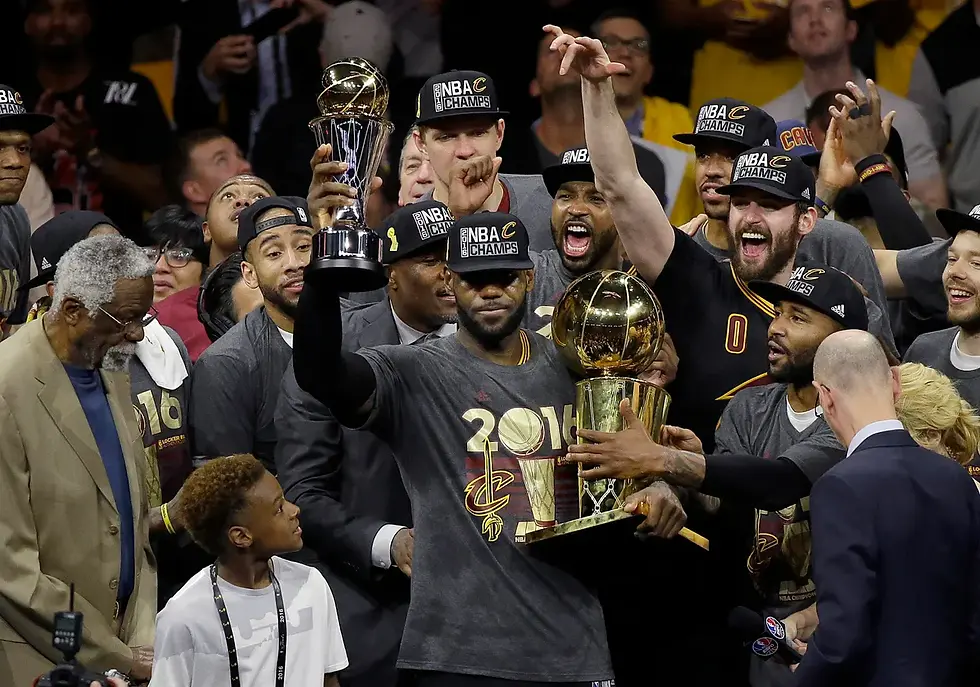
7. Cleveland Cavaliers, 2016
The Platinum Blue Dog
There is an argument that this is the greatest Blue Dog in the history of American sports.
The 2016 Cleveland Cavaliers were good.
Let's get that out of the way.
They weren't some eighth seed miracle.
They were the Eastern Conference's No. 1 seed.
They had LeBron James.
They had Kyrie Irving.
They had Kevin Love.
They were a legitimate championship team.
But then they ran into the Golden State Warriors.
And Golden State had just completed the greatest regular season in NBA history.
73–9.
The Warriors broke the NBA record for regular-season wins.
They were defending champions.
They had Stephen Curry, the reigning unanimous MVP.
And then they went to the Finals.
The Cavaliers had their chance.
They lost Game 1.
They lost Game 2.
They won Game 3.
They lost Game 4.
And suddenly Cleveland was staring at elimination.
3–1.
One loss.
That's all it would take.
For Golden State to win its second straight championship.
For the 73-win season to end with the trophy.
For Cleveland to fall short again.
Historically, teams in that position don't come back.
Especially not in the NBA Finals.
Especially not against a team that had just won 73 games.
Especially not when the opponent had already beaten you in the previous year's Finals.
But Cleveland won Game 5.
Then Game 6.
And suddenly the impossible was one game away.
Game 7 went back to Oakland.
The series was tied.
The season was reduced to 48 minutes.
And eventually, the score was tied late in the fourth quarter.
Then came one of the most famous defensive plays in NBA history.
LeBron James chased down Andre Iguodala and blocked his layup.
A few possessions later, Kyrie Irving hit one of the most famous three-pointers in NBA history.
Cleveland held on.
93–89.
The Cavaliers were NBA champions.
The first championship in franchise history.
And, perhaps more importantly, the city of Cleveland finally had its first major professional sports championship in more than half a century.
The NBA describes the championship as a historic comeback against the 73-win Warriors; Cleveland had gone 57–25 in the regular season before becoming the first team to overcome a 3–1 deficit in the Finals.
And this is perhaps the most important distinction of the entire Blue Dog concept:
The Cavaliers weren't the underdog because they were bad.
They were the Blue Dog because of the situation they were in.
Down 3–1.
Against 73–9.
In the Finals.
Against the defending champions.
With history saying:
No.
No.
No.
No.
And Cleveland kept saying:
Yes.
That's a Blue Dog.
Not a bad team.
Not a miracle roster.
A team entering a situation where the reasonable conclusion was that the story was already over.
And then changing the ending.
If Leicester is the classic underdog, Cleveland is something more violent.
It is the Blue Dog looking at the door marked IMPOSSIBLE and kicking it down.
Verdict: Platinum Blue Dog.

8. Boavista, 2000–01
When the Establishment Got Mugged
Sometimes a Blue Dog is about one game.
Sometimes it's about an entire season.
And sometimes it's about walking into an established football hierarchy and completely fucking ruining everyone's plans.
Boavista did that in Portugal.
For decades, Portuguese football was dominated by the country's traditional giants.
Benfica.
Porto.
Sporting.
These were the clubs that defined the title race.
The clubs with the history.
The trophies.
The resources.
The expectations.
Then, in 2000–01, Boavista won the Primeira Liga.
Their first and, to date, only Portuguese league championship.
And suddenly the traditional order had been interrupted.
That is a beautiful kind of sporting chaos.
Boavista weren't some random amateur club.
They had already been competitive.
They had finished second in the league before.
They had won domestic cups.
They were an established top-flight side.
But winning the league meant breaking the traditional order.
For one season, Portugal wasn't Benfica's country.
It wasn't Porto's.
It wasn't Sporting's.
It was Boavista's.
And that makes them interesting in the Blue Dog conversation.
Because Blue Dogs don't necessarily need to come from nowhere.
Sometimes they simply need to walk into a room where everybody thinks they know how things are supposed to work and say:
Actually, no.
The thing that keeps Boavista from being a Pure Blue Dog is that their success wasn't quite as structurally absurd as Hull's.
They were already a legitimate first-division club.
They had been building toward the top.
They were not a team that had escaped relegation and immediately won everything.
They weren't operating under the same impossible circumstances.
But they did something that football hierarchies aren't supposed to allow very often.
They broke the pattern.
And that's worth something.
Verdict: Blue Dog-adjacent / Fairytale Underdog.
So What Actually Makes Something a Blue Dog?
After all eight stories, I think we can finally answer the question.
A Blue Dog isn't necessarily the team with the longest odds.
It isn't necessarily the smallest club.
It isn't necessarily the worst roster.
It isn't even necessarily the most shocking champion.
The Blue Dog is about context.
It's about the collision between what should happen and what actually happens.
And that gives us a few rules.
Rule One: The Situation Matters More Than the Team
This is why Cleveland counts.
The Cavaliers were a great team.
But being down 3–1 against a 73-win Warriors team in the NBA Finals was fucking ridiculous.
The Blue Dog can be elite.
It just needs to be placed somewhere absurd.
This is also why Leverkusen counts.
They weren't underdogs by the time they were lifting trophies.
They were one of the best teams in Europe.
But going 51 matches without losing is so far beyond normal sporting expectation that the circumstances become the story.
The Blue Dog is not necessarily the worst participant.
It is the participant trapped inside the most ridiculous situation.
Rule Two: The Improbability Has To Be Meaningful
Not every upset is a Blue Dog.
A sixth seed beating a third seed isn't necessarily one.
A Premier League team beating another Premier League team isn't necessarily one.
A favorite losing one match isn't necessarily one.
The outcome needs to challenge the assumptions surrounding the event.
If Team A is slightly better than Team B and Team B wins, that's an upset.
If Team A is supposed to destroy Team B and Team B somehow wins, we're getting closer.
If Team B is supposed to be eliminated, has already survived elimination several times, and then continues surviving against increasingly ridiculous odds?
Now we're talking.
The Blue Dog needs the circumstances to matter.
Rule Three: One Miracle Isn't Always Enough
This is where Leicester becomes interesting.
Leicester winning the Premier League was extraordinary.
But once they established themselves as the best team in the league, they weren't surviving on one miracle.
They were just really fucking good.
The Blue Dog often has a sense of continued defiance.
Hull didn't just sneak into the playoffs.
They survived expectations.
Then reached the playoffs.
Then won the playoffs.
Then returned to the Premier League and started the next season unbeaten.
Leverkusen didn't simply win the Bundesliga.
They refused to lose for months.
Wrexham didn't simply earn one promotion.
They earned three.
Cleveland didn't simply steal Game 7.
They had to win three consecutive elimination games after falling behind 3–1.
There is usually some element of repetition.
The universe gets multiple opportunities to correct the mistake.
And it doesn't.
Rule Four: The Blue Dog Doesn't Care About Your Model
This might be the most important one.
Expected goals.
Expected points.
Power rankings.
Preseason projections.
Betting odds.
Historical precedent.
All useful.
All important.
All fucking breakable.
Hull's 2025–26 season is almost the perfect example because the underlying numbers were practically screaming that their results weren't supposed to continue.
And they did anyway.
The model can tell you what should happen.
It cannot make reality obey.
That's the beauty of sport.
Statistics describe probability.
They don't enforce it.
The Blue Dog Scale
So, after all this, here's my completely unofficial and probably unnecessary ranking system.
Level | Example | Classification |
1 | Normal upset | Underdog |
2 | Burnley 2017–18 | Blue Dog-adjacent |
3 | Leicester 2015–16 | Legendary Underdog |
4 | Sunderland's rise to Europe | Fairytale Underdog |
5 | Bayer Leverkusen 2023–24 | Blue Dog |
6 | Wrexham's three promotions | Blue Dog Dynasty |
7 | Cleveland 2016 | Platinum Blue Dog |
8 | Hull City 2025–26 | Pure Blue Dog |
And yes, I realize I have invented an entirely new sports classification system based on a dog from a Nintendo game.
I stand by it.
Actually, I think there is an argument that the terminology makes sports discussions more fun.
Imagine somebody tells you:
"Yeah, I think this is a big underdog story."
And you get to respond:
"Yeah, but is it a Blue Dog?"
That question immediately forces us to think about the circumstances.
Is this genuinely improbable?
Is it merely unexpected?
Is the team actually bad?
Is the opponent historically dominant?
Is there a repeated pattern of defying expectations?
Is the improbability coming from the result itself, or from the situation surrounding it?
Suddenly, we've got a framework.
A completely stupid framework.
But a framework nonetheless.
Why We Love The Blue Dog
There is something deeply satisfying about an underdog story.
Sports is, in many ways, built around hierarchy.
Money matters.
Talent matters.
History matters.
Resources matter.
Recruitment matters.
Home advantage matters.
Statistics matter.
The best team is supposed to win.
The strongest player is supposed to dominate.
The richest club is supposed to have the deepest squad.
The favorite is supposed to beat the outsider.
And most of the time?
It works.
That's why the Blue Dog is so fucking special.
Because occasionally, the machine breaks.
Sometimes a little team finds a way.
Sometimes a veteran catches fire.
Sometimes a goalkeeper becomes possessed.
Sometimes a 95th-minute goal changes everything.
Sometimes a 73–9 team loses three straight Finals games.
Sometimes a team that was supposed to finish near the bottom finishes sixth.
Sometimes a newly promoted team looks at the Premier League and decides it doesn't give a shit.
And sometimes a tiny blue dog wins a race after nearly 25 years of everybody assuming it never would.
That's why I think the Blue Dog is a better metaphor for sport than simply "underdog."
Because the Blue Dog isn't necessarily about being weak.
It's about refusing to accept the conclusion that has already been written for you.
The Blue Dog doesn't have to be the worst team.
It doesn't have to be the smallest team.
It doesn't even have to be particularly good.
It just has to find itself in a situation where the world has already decided what happens next.
And then it doesn't cooperate.
Maybe That's Why We Watch
We spend so much time trying to predict sports.
Who will win the league?
Who will get relegated?
Who will make the playoffs?
Who will score?
Who will choke?
Who will surprise us?
We build models.
We make rankings.
We calculate odds.
We debate transfers.
We compare squads.
We argue about tactics.
We try to make sports predictable.
And then something happens that makes all of it look ridiculous.
That's the beauty of it.
If everything happened exactly as expected, sports would be boring as shit.
The Blue Dog is the reminder that probability is not destiny.
It is merely expectation.
And expectations can be broken.
That's why Leicester matters.
That's why Burnley matters.
That's why Leverkusen matters.
That's why Wrexham matters.
That's why Sunderland matters.
That's why Cleveland matters.
That's why Boavista matters.
And that's why Hull City matters.
Because somewhere along the line, all of these teams found themselves standing at the edge of something that didn't make sense.
Some crossed that line once.
Some lived there for an entire season.
Some built a fucking house there.
But the Blue Dog?
The Blue Dog simply kept running.
The Blue Dog Is Still Running
As I write this, Hull City have just drawn 0–0 with Aston Villa.
Three games into their first Premier League season after promotion.
Seven points.
Two wins.
One draw.
Three clean sheets.
Zero goals conceded.
Second in the table.
Villa controlled much of the possession.
Hull defended.
Villa created chances.
Hull survived.
And when the final whistle went, there was that ridiculous sentence again:
Hull City are unbeaten.
Three games into their first Premier League season after promotion.
No goals conceded.
Seven points.
Second place.
The story that began with:
"Can Hull survive?"
had become:
"Wait, what the fuck is Hull doing up here?"
And maybe that's the purest possible Blue Dog moment.
Because we're still asking the question.
We don't know where this goes.
There are still dozens of matches left.
Hull could finish 17th.
They could finish 10th.
They could finish 20th.
They could finish fourth.
They could collapse spectacularly.
They could stay up comfortably.
They could do something nobody saw coming.
And that's the point.
We don't know.
That's why the Blue Dog exists.
Because the story isn't interesting when we know exactly what happens next.
The Blue Dog is interesting because we don't.
And maybe that's what sport has always been about.
Not certainty.
Not probability.
Not predictions.
Possibility.
That tiny little gap between what should happen and what might happen.
The place where the impossible lives.
The place where a sixth-place Championship team goes to Wembley and scores in the 95th minute.
The place where a 73-win NBA team blows a 3–1 Finals lead.
The place where a club from the fifth tier climbs three divisions in three years.
The place where Bayer Leverkusen simply refuses to lose for 51 games.
The place where Leicester City wins the Premier League at 5,000–1.
And somewhere in a little Nintendo game from 2000, a slow blue dog is still waiting for its moment.
For 25 years, the Blue Dog looked like a joke.
Then it won.
And honestly?
That's the whole fucking point.
We spend our lives trying to figure out what is likely to happen.
Sports gives us the privilege of being wrong.
And sometimes, being wrong is the greatest part.
Because sometimes the favorite wins.
Sometimes the numbers are right.
Sometimes the script plays out exactly as expected.
But every once in a while, something slips through.
Something weird.
Something improbable.
Something that wasn't supposed to happen.
Something that makes you look at your predictions, your models, your assumptions and your perfectly reasonable expectations and laugh.
Sometimes the world gets it wrong.
Sometimes the underdog wins.
And sometimes the underdog isn't even enough of a word.
Sometimes the Blue Dog wins.
And that's why we watch.
Theron Norrington
Founder & Editor, OffTheRecord
Independent journalism exploring the stories that shape sport, culture, and the world beyond the headlines.
Sources / Further reading
The Blue Dog, Vidya James / Zelda community research: The Blue Dog investigation, including the charity-stream attempts and the statistical absurdity surrounding the race. Zelda Dungeon — “The Blue Dog from Majora’s Mask, a True Underdog, Finally Wins Race”
The Blue Dog, Falkush's search: Coverage of the eventual 8,410-race search that produced the Blue Dog victory. Nintendo Life — “After Almost 25 Years, Majora’s Mask’s Blue Underdog Has Finally Nabbed A Racing Win”
Leicester City: Premier League historical coverage of Leicester's extraordinary 2015–16 title campaign and 5,000–1 odds. Premier League — Leicester City season coverage
Bayer Leverkusen: Bundesliga's account of the 2023–24 unbeaten campaign, including the 34-game unbeaten Bundesliga season and historic run. Bundesliga — Bayer Leverkusen's unbeaten run
Wrexham: Associated Press coverage of Wrexham's 2025–26 seventh-place finish and the club's three consecutive promotions. Associated Press — Wrexham's Championship season
Wrexham/Hull final-day battle: BBC Sport's breakdown of the extraordinary three-way fight for the final Championship playoff place. BBC Sport — “How Hull came out on top of their shootout with Wrexham and Derby”
Hull City: Premier League's detailed account of Hull's 2025–26 promotion, including the Opta expected-points numbers, playoff run and Wembley victory. Premier League — Hull City promoted to the Premier League
Hull City vs. Aston Villa, September 5, 2026: Contemporary coverage of Hull's unbeaten start, seven points and three consecutive clean sheets. Sky Sports — Hull City 0–0 Aston Villa
Cleveland Cavaliers: NBA's retrospective on the 2016 championship and the historic comeback against the 73-win Warriors. NBA.com — Cleveland Cavaliers 2016 NBA Championship
Off The Record, September 2026
Photo Credits
Photos: Nintendo, Leicester City Football Club, Premier League, Burnley FC, Bayer 04 Leverkusen, Bundesliga, Wrexham AFC, English FA, Hull City AFC, EFL, Sunderland AFC, NBA, Boavista FC, Liga Portugal, AFP/Getty Images, and credited photographers where applicable.
All photographs remain the property of their respective copyright holders. OffTheRecord does not claim ownership of third-party imagery.
© 2026 OffTheRecord. All rights reserved.


Comments